
Elmer McCurdy: The Outlaw Whose Mummified Corpse Became a Carnival Attraction
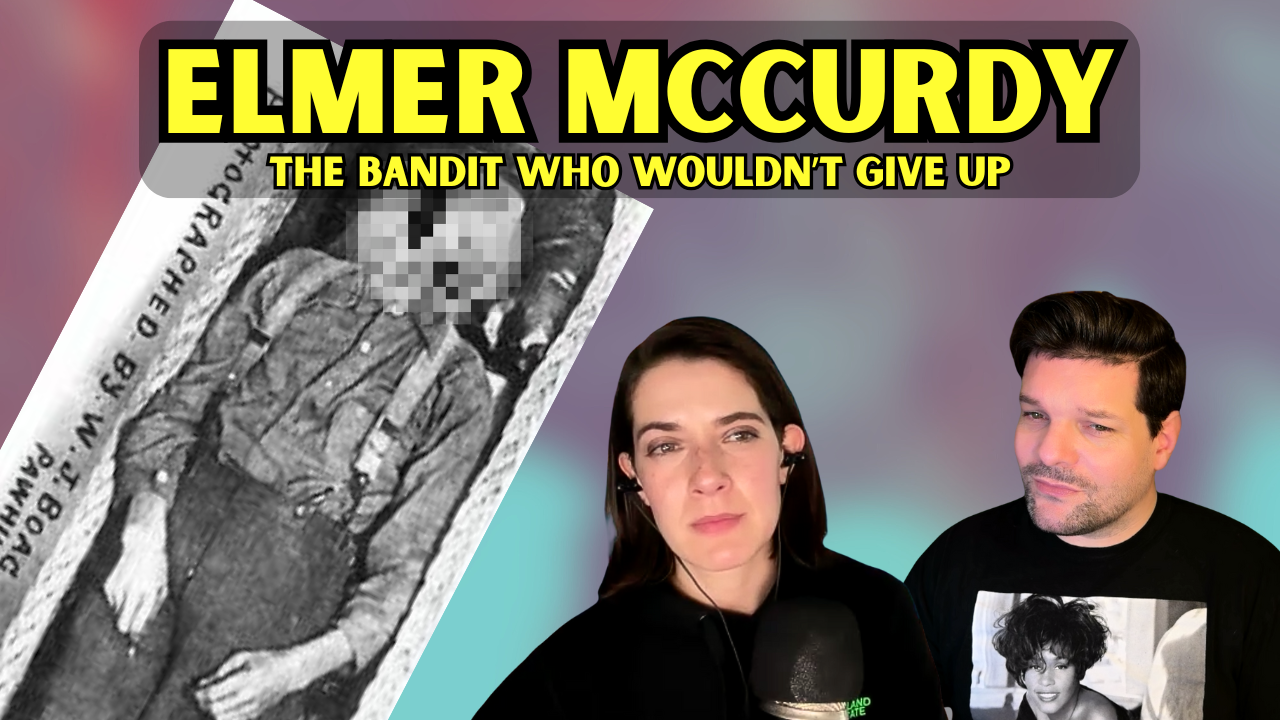
The story of Elmer McCurdy is one of the strangest and most disturbing true crime stories in American history. What began as the short and unsuccessful criminal career of an early 1900s outlaw evolved into a bizarre decades-long postmortem journey in which McCurdy’s embalmed corpse was displayed at carnivals, museums, horror attractions, and amusement parks across the United States.
For more than sixty years after his death, thousands of people unknowingly stared at the real body of a dead outlaw, believing it was merely a wax dummy or carnival prop.
Who Was Elmer McCurdy?
Elmer McCurdy was born on January 1, 1880, in Washington under complicated circumstances. His mother, Sadie McCurdy, was only seventeen and unmarried at the time of his birth. To avoid social scandal, Elmer was raised by his uncle George McCurdy and George’s wife Helen, believing they were his real parents.
After George died from tuberculosis in 1890, Elmer eventually learned that Sadie was actually his biological mother. According to later accounts, this revelation deeply affected him emotionally and contributed to his rebellious behavior and growing alcohol abuse.
As a teenager, Elmer ran away from home and worked as an apprentice plumber, where he reportedly showed real talent as a tradesman. But after the deaths of both his mother and grandfather in 1900, McCurdy drifted across the country working various jobs under aliases while increasingly struggling with alcoholism.
Elmer McCurdy’s Criminal Career
In 1907, McCurdy enlisted in the United States Army and served at Fort Leavenworth. During his military service, he received basic explosives training involving nitroglycerin.
After leaving the Army in 1910, McCurdy quickly fell into criminal circles.
He and a friend were first arrested for possessing burglary tools, though they were eventually acquitted. Soon afterward, McCurdy partnered with more experienced criminals and began participating in train robberies and bank heists throughout Oklahoma and Kansas.
Unfortunately for McCurdy, he proved to be an extremely incompetent outlaw.
The Failed Train Robberies
In March 1911, McCurdy helped rob the Iron Mountain–Missouri Pacific train near Lenapah, Oklahoma. Hoping to steal thousands of dollars, McCurdy used too much nitroglycerin on the train safe, causing a massive explosion that melted much of the silver currency inside. The gang escaped with only about $450 worth of damaged coins.
Months later, McCurdy participated in a bank robbery in Kansas that also failed spectacularly after another excessive nitroglycerin blast destroyed much of the bank interior without opening the inner vault.
Then, in October 1911, McCurdy attempted what became one of the most infamous failed train robberies in Old West history.
The gang intended to rob a Katy train carrying approximately $400,000 in Osage Nation royalty payments. Instead, they accidentally stopped the wrong passenger train.
The robbery yielded:
$46 in cash
A revolver
A coat
A conductor’s watch
Two jugs of whiskey
Newspapers mocked the robbery as one of the smallest train heists ever recorded.
The Death of Elmer McCurdy
After the failed robbery, McCurdy retreated to a ranch near Bartlesville, where he heavily drank stolen whiskey while suffering from illness, including pneumonia and tuberculosis symptoms.
Unbeknownst to him, authorities had already placed a $2,000 bounty on his capture.
On October 7, 1911, a posse of deputy sheriffs tracked McCurdy to a hay shed using bloodhounds. A lengthy shootout erupted after McCurdy opened fire on the officers.
Roughly an hour later, McCurdy was shot once in the chest and died at the scene. He was only 31 years old.
“The Bandit Who Wouldn’t Give Up”
After McCurdy’s death, his body was taken to undertaker Joseph L. Johnson in Pawhuska, Oklahoma. When nobody came forward to claim the corpse, Johnson embalmed the body using arsenic-based preservatives.
Months passed without family members retrieving the remains.
Eventually, Johnson began displaying McCurdy’s embalmed body to paying customers under the nickname “The Bandit Who Wouldn’t Give Up.” Visitors paid five cents to view the dead outlaw posed upright with a rifle in his hands.
This marked the beginning of one of the strangest journeys any corpse has ever taken.
Elmer McCurdy’s Corpse Becomes a Carnival Attraction
In 1916, two men falsely claiming to be McCurdy’s relatives arrived to collect the body. They were actually carnival promoters James and Charles Patterson, who transported the corpse into the traveling sideshow circuit instead.
Over the following decades, McCurdy’s body traveled throughout the United States appearing in:
Traveling carnivals
Crime museums
Roadside attractions
Horror exhibits
Exploitation film promotions
As the years passed, the corpse naturally mummified and shriveled. Eventually, many owners believed it was simply a wax figure or prop.
In the 1930s, filmmaker Dwain Esper used the body to promote his exploitation movie Narcotic!. Later, McCurdy briefly appeared in the 1967 horror film She Freak.
The Shocking 1976 Discovery
By the 1970s, McCurdy’s body hung inside the “Laff in the Dark” funhouse at The Pike. It had been painted fluorescent red and suspended from a noose as a spooky decoration.
Everything changed on December 8, 1976.
While filming an episode of the television show The Six Million Dollar Man, a crew member attempted to move what everyone believed was a mannequin. The prop’s arm suddenly snapped off, exposing real human bone and tissue underneath.
Police and coroners quickly determined the horrifying truth: the “dummy” was an actual human corpse.
How Investigators Identified Elmer McCurdy
An autopsy conducted by the Los Angeles County Coroner’s Office confirmed the remains belonged to a man who had died from a gunshot wound to the chest decades earlier.
Investigators discovered:
Arsenic embalming chemicals
Old autopsy incisions
The original bullet fragment still lodged in the chest
Ticket stubs from a traveling crime exhibit
A 1924 penny hidden inside the mouth
Forensic anthropologist Dr. Clyde Snow later used historical photographs and skull analysis to positively identify the corpse as Elmer McCurdy.
Elmer McCurdy’s Final Burial
After national media coverage exposed the bizarre story, several funeral homes volunteered to bury McCurdy properly.
In 1977, McCurdy was finally laid to rest in the Boot Hill section of Summit View Cemetery in Guthrie. Approximately 300 people attended the graveside service.
To ensure nobody would ever steal or display the body again, officials poured two feet of concrete over the casket after burial.
After sixty-six years as a carnival attraction, Elmer McCurdy was finally allowed to rest in peace.
Why Elmer McCurdy’s Story Still Fascinates People
The bizarre case of Elmer McCurdy remains one of the strangest intersections of true crime, carnival history, and American folklore. His story reflects the unusual entertainment culture of the early twentieth century, when traveling sideshows and crime exhibits blurred the lines between spectacle and morality.
More than a century after his death, McCurdy’s accidental transformation from failed outlaw to mummified tourist attraction continues to shock and fascinate true crime audiences around the world.
